


Mark MacDonald was at a loss.
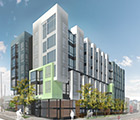
Like market-rate developers across San Francisco, his approved 425-unit mid-rise building at 300 DeHaro in Potrero Hill was stuck, victim of the familiar combination of high interest rates and construction costs. The cost of the project had doubled since he bought the site in 2019, and with San Francisco struggling to recover from the pandemic, the pension funds and banks that typically bankroll such projects were missing in action.
PRESS
Read DM Development's latest news and press releases
San Francisco developer turns stalled housing project into 425 affordable apartments
But, rather than wait for the economics to make sense, MacDonald did something he had long wanted to do: He got into the affordable housing business.
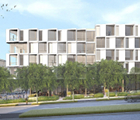
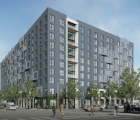
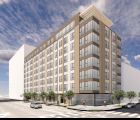
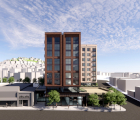
On Monday MacDonald’s company, DM Development, celebrated the groundbreaking of a 300 DeHaro building that will feature 425 studio and junior one-bedroom units. The project is unusual not just for its size — it is two or three times the size of a typical affordable complex — but because DM Development is a market-rate builder entering a world of affordable housing development that is renowned for a byzantine regulatory calculus that can make for-profit building seem like basic math.
Over an 18-month period MacDonald navigated a maze of funding sources that included LIHTC — low-income housing tax credits — and tax-exempt bond financing administered by the California Debt Limit Allocation Committee and the California Tax Credit Allocation Committee. DM partnered with MRK Partners, which manages 4,500 affordable units.
The construction site at 300 DeHaro St., which was initially planned for market-rate housing but will now sprout affordable homes.
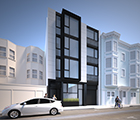
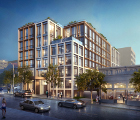
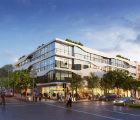
Even for a builder who has constructed a dozen sophisticated condo projects from the Marina to Hayes Valley to Dogpatch, the process was a revelation.
“We had heard about the complexity of LIHTC, but we didn’t have a full appreciation until we went through it,” he said.
The apartments will be affordable to individuals and families earning between 30% and 70% of the area median income, approximately $41,000 to $95,000 per year, based on current figures. The units will be small — 300 and 400 square feet — with Murphy beds that convert from a sofa and dining table by day to a queen-size bed by night. There will be community lounges, a fitness center and a shared kitchen that opens onto a rooftop deck. The project will feature approximately 6,000 square feet of neighborhood-serving retail space along 16th and De Haro streets, as well as a 7,000-square-foot landscaped rear yard.
For a city with a state mandate to plan for 82,000 units by 2031 — more than half of which must be affordable to low- and moderate-income households — 300 DeHaro could be a trailblazer. The project took advantage of financing mechanisms that in San Francisco are typically used by nonprofits, but unlike those projects it is not receiving any city money.
And the project could be a model for its efficiency. MacDonald said his group was able to build the units for less than $500,000 a unit, roughly 40% cheaper than comparable projects, and similar to 1633 Valencia St. DM was able to save money through designing efficient floor plans and strong relationships with subcontractors cultivated over 15 years and more than a dozen projects.
“Nothing is being built, so the subcontracting community is really hungry,” he said. “They want to keep their crews together. They want to keep the lights on. Margins are not as important as they were in 2019. There is a lid on costs right now. They are still high, but it’s not like they are going up 1% a month like they were in 2019.”
MacDonald said he has always wanted to broaden his development portfolio to include deed-restricted affordable housing.
“This is not just a one-time thing we are doing because of market conditions,” he said. “It just so happens that the market-rate stuff is on hold, so we saw this as an opportunity to start this business.
“Now we understand the process. We know where the land mines are. It will be that much easier the next go-round.”
Although 300 DeHaro won’t open until 2027, he said he is lining up other affordable projects.
“There are several other sites that we have control over that we had envisioned as market-rate deals that we are looking to pivot to LIHTC,” he said. “We are not giving up on market rate, but for the near term this is our strategy.”
The DeHaro project has not been without controversy. Neighbors objected to the 11-story height — it’s considerably taller than anything nearby — and residents had little chance to weigh in because the project took advantage of Senate Bill 35, which creates a streamlined, ministerial approval process for qualified multifamily projects in cities and counties that have failed to meet state-mandated housing goals.
J.R. Eppler, president of the Potrero Hill Boosters Neighborhood Association, called the fact that the project will be 100% affordable “an additional benefit” but said, “neighbors are unsure of how it will work.”
“This development isn’t like any that we have had over the last 15 years of intense development on the hill — I think neighbors are unsure exactly how it will work,” Eppler said. “Because the project proceeded under (SB35) there was no additional conversation with the community about the project.”
Alison Heath, a longtime Potrero resident who has been a critic of the project, said it was unclear who the micro-units would appeal to. “You are squeezing people into very, very small units,” she said. “I’m distrustful about what is really happening here.”
MacDonald said, “Of course not everyone is happy, but we are hopeful in time this will be seen as a positive.”
“One would think the neighborhood would be supportive of affordable housing, but in reality that is not necessarily the case,” he said.
While nonprofit developers have sometimes been skeptical of market-rate builders getting into the affordable housing space, Council of Community Housing Organization Executive Director Quintin Mecke said he is not worried.
“I don’t think there is a concern amongst our folks that we will lose on financing to private developers,” he said. “We are always looking to expand opportunities for affordable places to live, not narrow them. Hopefully these units will house folks working in our restaurants and service industry, who can’t find affordable housing anywhere else.”
Sam Moss, executive director of the Mission Housing Development Corp., said nonprofits like his organization should be prioritized because they have the expertise in managing affordable communities, but “in a world where there are enough tax credits for everybody and DM wants to build low-income housing for 500 people, I say go for it.”
“I have never been someone that thinks that one side — nonprofit or for-profit — should stay in their lane,” he said. “If they are building more affordable housing, I say build away.”