






PRESS
Read DM Development's latest news and press releases
San Francisco developers see opportunity in affordable housing thanks to expanded tax credit
Mark MacDonald is eyeing his next apartment project in San Francisco’s Mission District.
Normally, the CEO of DM Development would be preparing to build almost 170 units of market-rate housing at the 321 Florida St. site, tapping into the city's tech-fueled rebound. San Francisco has become the epicenter of the AI boom — and the nation’s hottest rental market. Rents across the metro have jumped 4.7% over the past year, while prices in the city itself have spiked 11.5%, according to Apartment List.
But across San Francisco, a deeper shift is underway. Market-rate projects are stalled while affordable housing is accelerating. In one of the nation’s most expensive cities, investors want higher returns than new construction can deliver, even as rents rise.
At the same time, a federal policy change has unlocked a surge of Low-Income Housing Tax Credits, giving affordable projects a financing advantage just as the city rezones to meet state housing mandates. The result is a rare moment where public policy, private capital, and market demand are pushing development toward affordability.
The Mission site — along with three or four others DM controls in San Francisco, totaling as many as 1,000 units — is more likely to follow the model of 300 DeHaro, the 425-unit affordable complex the firm broke ground on last week in Potrero Hill.
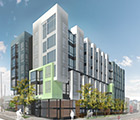
That development, designed by BAR Architects, will serve residents earning 30% to 70% of area median income. Originally approved as market-rate, the 11-story project pivoted to 100% affordable when financing collapsed, relying on Low-Income Housing Tax Credits and tax-exempt bonds to move forward.
“Market-rate investment is virtually impossible,” MacDonald said.
Institutional investors now demand 6% to 7% returns on current rents and expenses, without assuming growth. No more padding the pro forma with 2% or 3% annual rent hikes. That bar is well above San Francisco’s historic 5% return range, leaving most market-rate projects stalled.
Tax credits unlock development
Affordable housing is advancing thanks to a recent federal policy change. Earlier this year, Congress passed the “Big Beautiful Bill,” which cut the amount of bond financing projects must use to qualify for 4% Low-Income Housing Tax Credits.
That shift means the same pool of tax-exempt bonds can now finance nearly twice as many deals. More deals lower borrowing costs, improve project economics, and ultimately make construction possible.
For California, where the old rules routinely drained the state’s bond authority, the change is a breakthrough. National consultancy Novogradac estimates the reforms could generate as many as 1.4 million additional affordable homes nationwide by 2030.
“Affordable housing tax credits will be twice as available, so we should see a pickup in development,” said Jeff Hoopes, president of the West Coast region for construction firm Suffolk.
The city sees a comeback
That acceleration comes as San Francisco decides where new housing will go. The city is deep into a rezoning push, months ahead of a state-imposed January 2026 deadline. Under California’s regional housing needs allocation, San Francisco must make room for 82,069 units between 2023 and 2031 — more than half of them affordable.
Taken together, the financing shift, zoning overhaul, and economic rebound mark a turning point. San Francisco, once the poster child for the "doom loop" — crime, homelessness, plunging rents and tech layoffs — is showing signs of revival.
Developers see people returning, AI firms filling office space, and public safety improving. For them, it signals the worst of the downturn is over and the next wave of construction, led by affordable housing, is underway.
“The city desperately needs all types of housing,” MacDonald said. “We’re going to get it built, whether market-rate or affordable.”