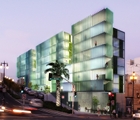
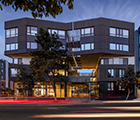
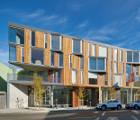
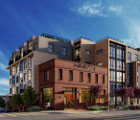
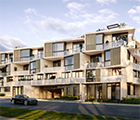
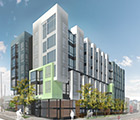
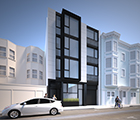
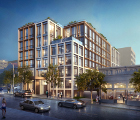
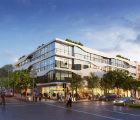
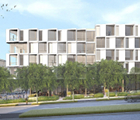
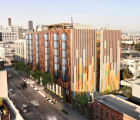
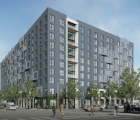
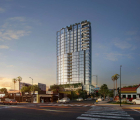
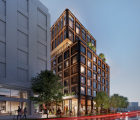
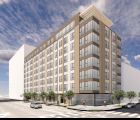
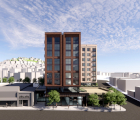

This week, two developers filed plans to construct a 21-story tower at 360 Fifth St., a site so blighted that the city sued a former owner over allegations the vacant property had become a public nuisance.
PRESS
Read DM Development's latest news and press releases
With rents surging, developers race to build San Francisco apartments again
The developers behind that proposal, DM Development and Thompson Builders, hope to break ground next year on the project, which is slated to have 273 homes.
The same development team is gearing up to start work this fall on 321 Florida St. in the Mission District, a 152-unit complex on what is now a surface parking lot.
DM Development Co-Founding Principal Mark MacDonald said equity investors are finally willing to pour money back into San Francisco. And with 56,000 approved units in the city’s development pipeline, there will be plenty of builders eager to get going.
“There is going to be a wave of development and I think it could be significant,” said MacDonald. “At this point it’s all about speed to market.”
Projects expected to break ground soon include 203 units on a former car wash at 400 Divisadero, 75 homes at the Wash Club laundromat at 2918 Mission St., 342 units at Dogpatch Power Station and 350 apartments at Pier 70. That number could expand greatly next year if Align Real Estate Partners starts construction as planned on its proposal to build 848 units on the site of the Marina Safeway.
The optimism is in stark contrast to even six months ago when many market-rate developers were looking at building subsidized affordable projects because they couldn’t get equity investors to come to the table. That was the case with 321 Florida, where MacDonald applied for low-income tax credits. But with rents in the Mission up about 10% year-over-year, and occupancy at about 95% in the neighborhood, “market rate is feasible again,” he said.
MacDonald said both 321 Florida and 360 Fifth St. will follow an amenity-rich model established by Strada Investment Partners at 555 Bryant St., a 500-unit community in SoMa,one of the few market-rate buildings to open since the pandemic. That means hot and cold plunges, co-working spaces, private offices, indoor and outdoor fitness centers, libraries, rooftop gardens and recreation lounges and theaters.
“Given the dramatic income growth we have seen, there is now demand for larger units, for well-appointed units in buildings with big amenity packages,” said MacDonald.
While a building boom should eventually help drive down rents, the first wave of buildings won’t be ready for occupancy until late 2028, providing little immediate relief. And it will barely put a dent in the city’s struggle to meet the state-mandated goal of permitting 82,000 units by 2031. Nearly half way through the cycle, about 6,500 units have been completed.
The first crop of new buildings will be rental rather than condo and will be aimed at the upper end of the market. While before the pandemic developers were shrinking the size of units to generate more density and higher returns, the next wave of buildings will have larger floorplates and more common spaces, according to developers. It would likely do little to offer relief to lower and middle income workers struggling to afford the city, which could be a political liability for Mayor Daniel Lurie.
Marc Babsin, CEO of developer Emerald Fund, credited the city’s recent reduction in the amount of onsite affordable units that market-rate developers are required to build for making projects feasible. The requirement for large projects was rolled back from 25% to 15% in 2023 and from 15% to 5% in July.
“The 5% inclusionary that the board passed is the most consequential piece of legislation that I have ever seen in terms of stimulating housing development,” he said. “In 12 months there will be a bunch of tower cranes, in 24 months there will be even more.”
Enrique Landa, managing partner of Fifth Space, the developer of the Dogpatch Power Station, recently announced that JPMorgan Chase has agreed to establish a $200 million fund that will help finance the next big milestone of the Dogpatch Power Station: A 342-unit building on San Francisco’s Central Waterfront. The announcement coincided with JP Morgan Chase CEO Jamie Dimon visiting the site.
“You are seeing a very clear story about rent increases and demand and people fighting to get back into spaces, which is really hard. That creates a condition where capital is willing to take a risk again,” said Landa.
The vote of confidence was a far cry from what Landa and other builders went through over the past six years.
“For a long time I would go to New York and bankers and capital providers would treat me like I had leprosy – San Francisco was so toxic they didn’t want to catch whatever disease I had,” he said. “And then two weeks ago I had Jamie Dimon on my roof.”
But Landa cautioned that the market is still “not totally back” because not all projects in the pipeline are economically feasible and some lenders are still wary of investing. Developers looking to attract equity need to offer a compelling story about job and rent growth and have permits to be able to break ground as soon as possible. All projects in the city that are going forward are in desirable neighborhoods – Lower Haight, Dogpatch, Eastern Mission – that have low vacancies and high rents and are popular among the young tech workers leading the AI revolution, he said.
“Everyone who is moving forward has a special party trick,” said Landa. “They have all worked hard to deliver something … impressive.”
Planning Department Chief of Staff Dan Sider said his staff is seeing a jump in interest from developers who want to get projects under way.
“We are hearing from builders that market conditions have shifted and apartment construction in San Francisco is starting to look attractive again,” he said. “Between regulatory reforms and strong housing demand, developers are looking to get projects going before things really take off again. These are sophisticated builders hustling to take advantage of the calm before the storm.”